Bose–Einstein condensate wiki
In condensed matter physics, a Bose–Einstein condensate (BEC) is a state of matter (also called the fifth state of matter) which is typically formed when a gas of bosons at low densities is cooled to temperatures very close to absolute zero (−273.15 °C or −459.67 °F). Under such conditions, a large fraction of bosons occupy the lowest quantum state, at which point microscopic quantum mechanical phenomena, particularly wavefunction interference, become apparent macroscopically. A BEC is formed by cooling a gas of extremely low density (about one-hundred-thousandth (1/100,000) the density of normal air) to ultra-low temperatures.
This state was first predicted, generally, in 1924–1925 by Albert Einstein following and crediting a pioneering paper by Satyendra Nath Bose on the new field now known as quantum statistics.
Critical temperature
This transition to BEC occurs below a critical temperature, which for a uniform three-dimensional gas consisting of non-interacting particles with no apparent internal degrees of freedom is given by:

where:
is the critical temperature, the particle density, the mass per boson, the reduced Planck constant, the Boltzmann constant and the Riemann zeta function; [14]



Interactions shift the value and the corrections can be calculated by mean-field theory. This formula is derived from finding the gas degeneracy in the Bose gas using Bose–Einstein statistics.
Derivation
Ideal Bose gas
For an ideal Bose gas we have the equation of state:
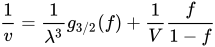
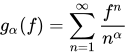
where is the per particle volume, the thermal wavelength, the fugacity and . It is noticeable that is a monotonically growing function of in , which are the only values for which the series converge.



![{\displaystyle f\in [0,1]}](https://wikimedia.org/api/rest_v1/media/math/render/svg/41c57ac0222bfe2602c3c23d82a400772087d030)
Recognizing that the second term on the right-hand side contains the expression for the average occupation number of the fundamental state , the equation of state can be rewritten as


Because the left term on the second equation must always be positive, and because , a stronger condition is
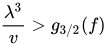

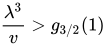
which defines a transition between a gas phase and a condensed phase. On the critical region it is possible to define a critical temperature and thermal wavelength:

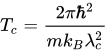
recovering the value indicated on the previous section. The critical values are such that if or we are in the presence of a Bose–Einstein condensate.


Understanding what happens with the fraction of particles on the fundamental level is crucial. As so, write the equation of state for , obtaining

and equivalently .
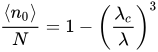
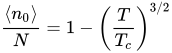
So, if the fraction and if the fraction . At temperatures near to absolute 0, particles tend to condensate in the fundamental state (state with momentum ).


Find more here


Comments
Post a Comment